Blog Single
Most health departments group these under “mobile food facilities,” but the operational reality is very different:
- Food truck: self-contained motorized vehicle (drive + kitchen in one unit).
- Food trailer: kitchen on a towable trailer (needs a towing vehicle).
- Food cart (pushcart/stand): smallest footprint; often limited prep and utilities depending on local rules.
Example (California guidance): a “mobile food facility” can include a truck, trailer, or cart, while some non-motorized carts/pushcarts may fall into a separate category with tighter limits on what you can sell.
At-a-Glance Comparison
| Category | Best for | Typical startup cost (very location-dependent) | Key advantage | Key tradeoff |
|---|---|---|---|---|
| Food Truck | City routes, moving with demand, full menus | Often $75k–$250k+ total (truck + build + permits, etc.) | “All-in-one” mobility | Highest capital + vehicle downtime risk |
| Food Trailer | Festivals, markets, semi-fixed spots, bigger kitchens | Often cheaper than trucks; examples include $15k–$50k for trailer ranges in many guides | More layout flexibility, lower entry cost | Needs tow vehicle + setup time |
| Food Cart | Testing ideas, tight budgets, high-foot-traffic vending | Commonly $5k–$10k baseline; can be higher in high-cost markets | Lowest barrier to entry | Menu/utility limits + location restrictions |
Important: Regulations vary by city/county—always confirm where you will actually operate.
Food Truck: Pros, Cons, and When It Wins
Why choose a food truck
- Maximum mobility: you can reposition quickly (lunch neighborhoods, late-night zones, pop-ups).
- Stronger “full kitchen” perception for customers and event organizers.
- Single integrated unit (no towing logistics).
What it typically costs
Cost breakdowns commonly cite:
- Used trucks and total startup costs spanning tens of thousands to 6 figures, with total startup frequently quoted around $75,000–$250,000+ depending on build, equipment, and permits.
Biggest risks
- Downtime risk: if the vehicle breaks, the business stops.
- Higher maintenance and insurance complexity versus simpler units (varies by region).
- Parking and routing constraints in dense cities.
Best fit menus: high-demand, fast throughput items (tacos, burgers, sandwiches, bowls) where you benefit from chasing crowds.
Food Trailer: Pros, Cons, and When It Wins
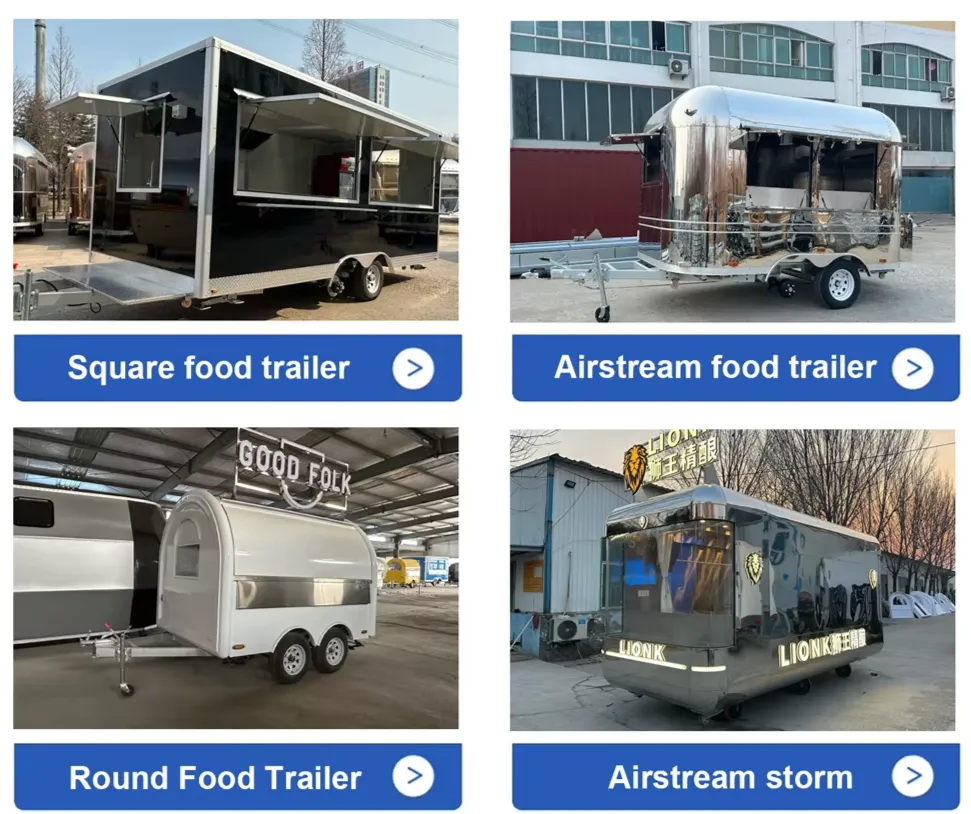
Why choose a food trailer
- Better kitchen layout options: trailers can be built for workflow (prep → cook → pass) and can be spec’d larger than many trucks.
- Lower entry cost vs trucks (often): many guides position trailers as the “middle ground.”
- Tow vehicle separation: if the tow vehicle has an issue, the kitchen unit may still be usable (depending on operations).
What it typically costs
Common ranges cited in industry breakdowns:
- Trailer-only costs (often) less than a truck, but you must budget for build-out, equipment, and towing capacity.
Operational considerations
- Setup time: hitching, leveling, power/water hookup, packing down.
- Site strategy matters: trailers shine where you park and sell for hours (farmers markets, fairs, weekly “residency” spots).
Best fit menus: coffee, shaved ice, pizza, BBQ, desserts—concepts that do great in festivals/markets and don’t require constant relocation.
Food Cart: Pros, Cons, and When It Wins
Why choose a food cart
- Lowest startup cost and fastest path to validating a concept.
- High profit potential on simple menus (when foot traffic is strong and labor is minimal).
What it typically costs
- Many guides cite $5,000–$10,000 as a common starting point for a basic cart (excluding permits/equipment/inventory), and note it can go higher in expensive markets.
The “hidden constraint”: what you’re allowed to sell
Rules can be strict:
- Some jurisdictions separate full mobile units from “compact” operations; carts/pushcarts may be limited to prepackaged foods or limited prep, while trucks/trailers can do more cooking if they meet requirements.
Best fit menus: hot dogs, coffee, pretzels, popcorn, shaved ice—simple, fast, low-waste items that don’t require a full kitchen.
Permits, Commissary, and “Real-World Compliance” (Why This Changes Your Choice)
Across many jurisdictions, you’ll see these recurring requirements:
1) Health permit + inspections
- Small business guidance commonly notes mobile food vendors often need health permits and inspections, and sometimes fire permits and proof of insurance depending on jurisdiction.
2) Commissary / support kitchen
- Many health departments require mobile units (including some carts) to operate with an approved commissary for storage, prep, utensil washing, water, and waste disposal.
3) Route sheets / operating locations / restroom access rules
- Example (Orange County, CA): mobile units may need route/event stop forms and may have restroom distance requirements when stopping for extended periods.
4) City-by-city differences
Even within one region, each city can set different rules, so your “perfect” unit type can become impractical if your target city restricts it.
Which One Should You Choose? A Simple Decision Checklist
Pick Truck if most of these are true:
- You need to move multiple times per day
- Your revenue depends on route optimization
- You need a full menu and fast repositioning
Pick Trailer if most of these are true:
- You plan to park and sell for hours (markets, festivals, breweries, event residencies)
- You want more kitchen flexibility for the same or lower budget than a truck
- You already have (or can justify) a proper tow vehicle
Pick Cart if most of these are true:
- You want the lowest-risk entry and fastest launch
- Your menu can work with limited prep and a small footprint
- Your business is foot-traffic dependent (downtown, parks, campuses)
FAQ
Is a food trailer cheaper than a food truck?
In many cost guides, yes—trailers are commonly presented as a lower-cost option than trucks, but you must include tow vehicle and setup logistics in your total budget.
Are food carts always easier to permit?
Not always. Carts may face stricter menu/food-prep limits and location rules, even if the equipment is cheaper.
Do trailers and carts require a commissary?
Often, yes. Many jurisdictions require mobile operations to be tied to an approved commissary for washing, storage, water, and waste handling.
Are You Looking for
Custom Food Trailers?
Free Contact Us Right Now
