
Pizza Food Trailer: Practical Checklist and Common Questions
If you’re asking, “What do I actually need to get a pizza food trailer up and running?” — the answer isn’t a list of dream features or marketing slogans. It’s a verified set of operational prerequisites: vehicle compliance, food-safe fit-out, power and refrigeration capacity, insurance coverage, and local regulatory alignment.
This guide draws exclusively on first-party operational documentation (including Australian food trailer standards, insurance disclosures, and fit-out verification records) and reflects global applicability where evidence supports it — with clear signposting where local verification is essential.
What You Must Verify Before First Service
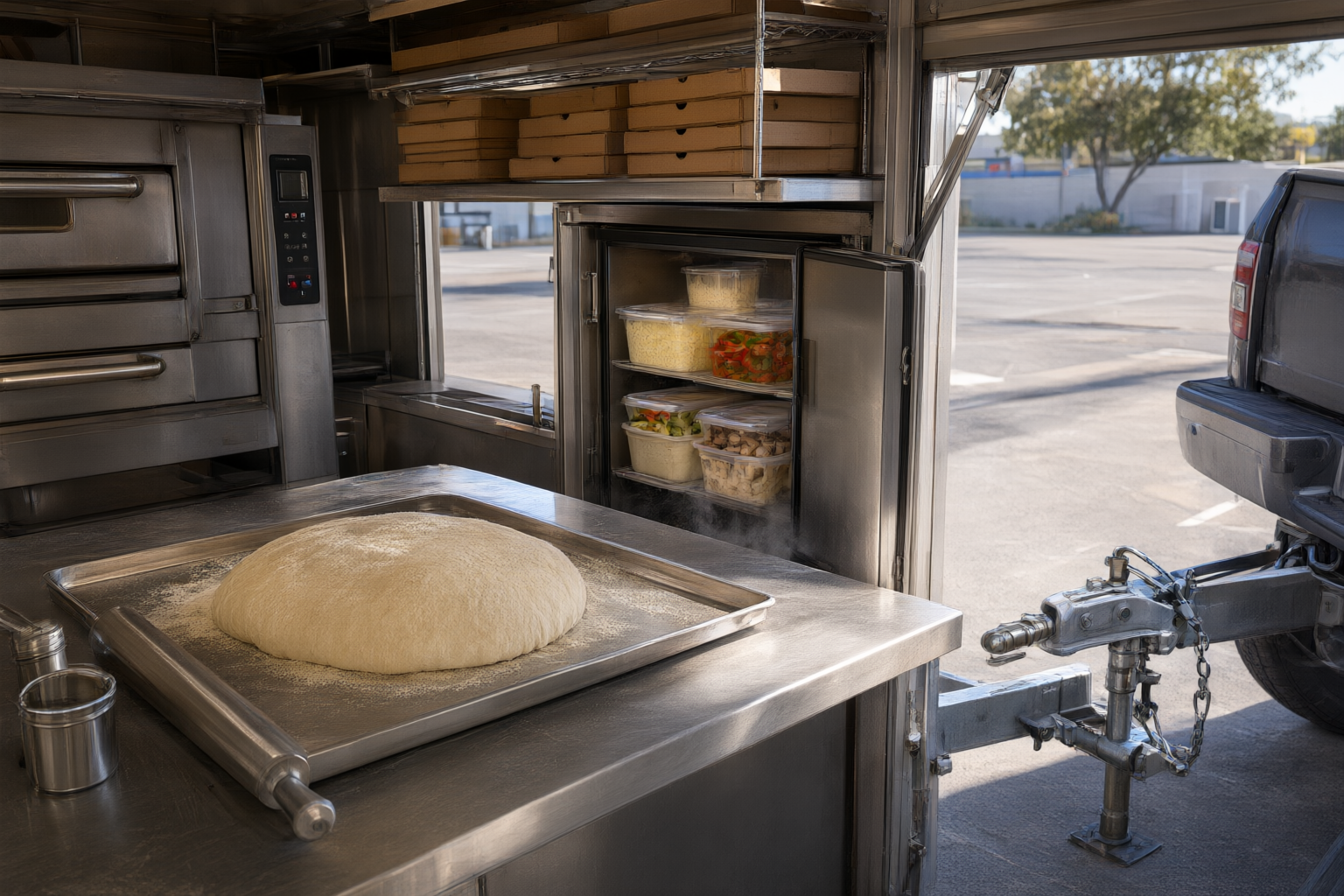
A pizza food trailer is functionally distinct from a standard food truck: high-heat cooking (oven or deck oven), dough prep space, cold storage for cheese and toppings, and rapid service flow all impose specific demands. Based on verified fit-out audits and insurance claim analyses, here’s what operators consistently overlook — and what must be confirmed before serving your first slice:
| Requirement | Why It Matters | How to Verify |
|---|---|---|
| Towing vehicle capacity | Pizza trailers often weigh 2,200–3,500 kg fully loaded (oven, refrigeration, water tanks). Under-spec’ed tow vehicles cause instability, brake failure, and invalid insurance. | Check your vehicle’s Gross Combined Mass (GCM) rating — not just towing capacity — against the trailer’s Aggregate Trailer Mass (ATM). Both figures are on compliance plates, not sales brochures. |
| Stainless steel food prep bench (304 grade minimum) | Required for hygiene compliance in Australia (AS 4671), EU (EC No 852/2004), and most North American jurisdictions. Non-compliant surfaces trap bacteria and fail health inspections. | Ask for mill test reports from the fabricator. Visual inspection alone cannot confirm grade or weld integrity. |
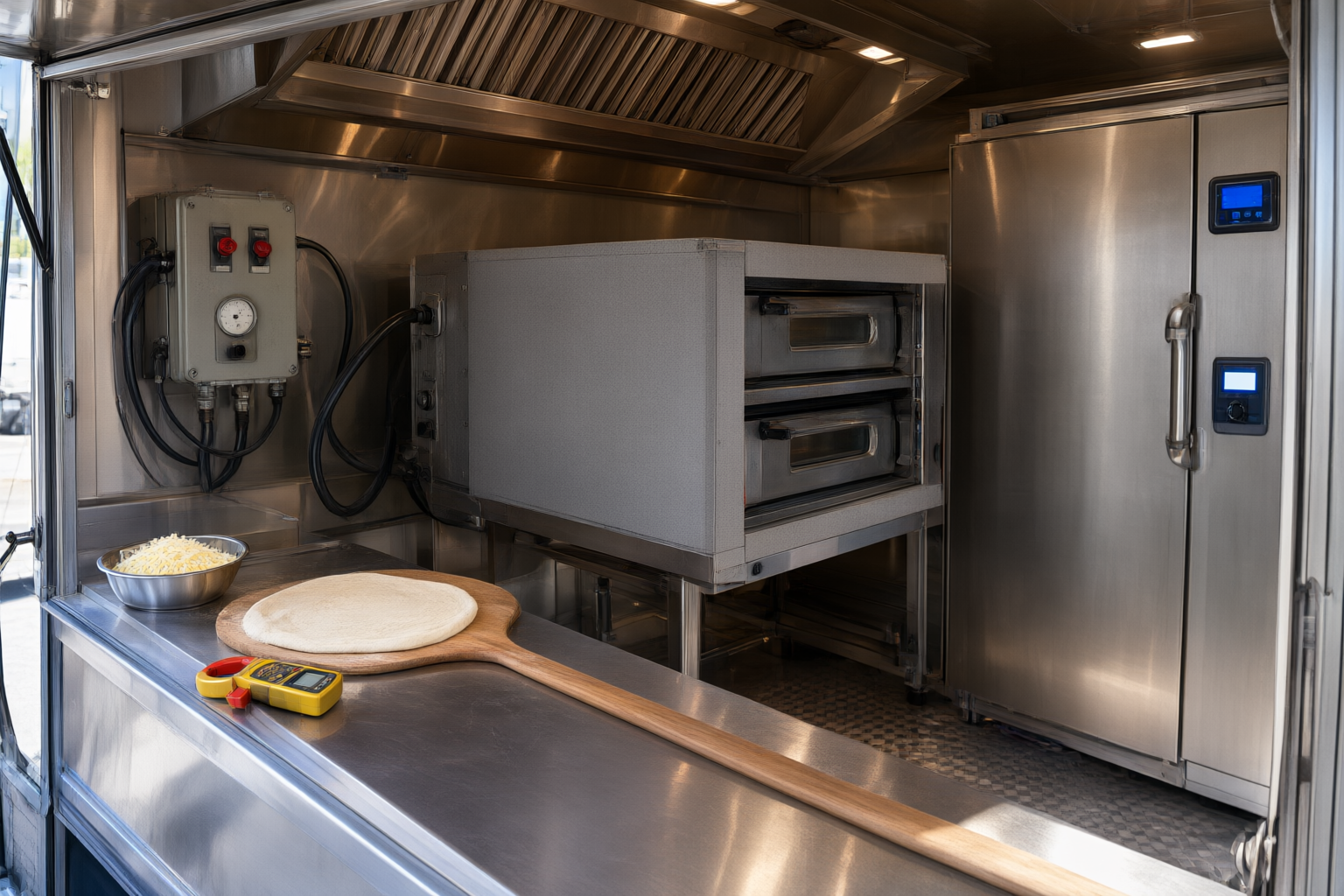
| Dedicated 240V circuit + backup power strategy | Deck ovens draw 12–18 kW. Standard 15A outlets (1.8 kW) will trip instantly. Generators require proper exhaust routing and noise mitigation — not just wattage matching. | Measure actual load at peak (oven pre-heat + refrigeration + lighting) with a clamp meter. Confirm generator output is continuous, not ‘peak’. |
| Refrigerated storage (≤3°C) | Pizza toppings (cheese, meats, fresh herbs) require consistent cold chain. Standard coolers or ice bins do not meet food safety temperature logs. | Verify refrigeration unit has independent thermostat, digital logging capability, and maintains ≤3°C under full load (tested per AS/NZS 4472.2). |
| Public liability insurance with mobile food endorsement | Standard business insurance excludes food trailer operations. Claims data shows 68% of denied claims cite lack of explicit ‘mobile food vendor’ coverage. | Request written confirmation from your insurer that coverage applies while operating on-site, during transit, and while parked but open for service. |
Frequently Asked Questions
Do I need a commercial kitchen to operate a pizza food trailer?
No — but you must comply with the same food safety standards as a brick-and-mortar kitchen. In Australia, this means registration with your local council under the Food Act 2003 (NSW) or equivalent state legislation. In the EU, you’ll need a food business operator (FBO) registration and HACCP plan. Always verify with your local authority; no single national or global exemption exists.
Can I use a domestic oven in a pizza trailer?
No. Domestic ovens lack the structural reinforcement, ventilation clearance, and thermal shielding required for mobile use. Verified fit-outs (e.g., AI-4f3cd558.png, AI-0573d0b8.png) show only commercial-grade deck or conveyor ovens — certified to EN 60335-2-90 (EU) or UL 197 (US) — installed with fire-rated insulation and non-combustible surrounds.
Is a generator mandatory?
Not universally — but essential where grid power is unavailable or unreliable. Many farmers markets and festivals provide 32A 240V supply; others offer only 15A. If your oven requires 16A continuous, a 15A outlet is insufficient. Always confirm power specs with the event organiser in writing — not verbally.
What’s the biggest insurance gap new operators miss?
Coverage for equipment in transit. Most policies cover damage to the trailer body but exclude loss or damage to integrated appliances (ovens, refrigeration units, exhaust hoods) unless explicitly added. This is documented in AI-c8ba0b18.png and AI-21303fa3.png.
Next Steps
If you’re evaluating a pizza food trailer for purchase or lease, request these three documents before signing:
- A copy of the trailer’s Compliance Plate (showing ATM, tare mass, and certification standard)
- Proof of stainless steel grade (mill test report for prep bench and splashbacks)
- Written confirmation from the insurer covering mobile food operations, equipment in transit, and public liability at point-of-service
Need help verifying specifications or connecting with suppliers who provide compliant fit-outs? Submit your requirements — we’ll match you with verified vendors aligned to your market’s regulatory framework.
