
How to Start a Food Trailer Business in the US
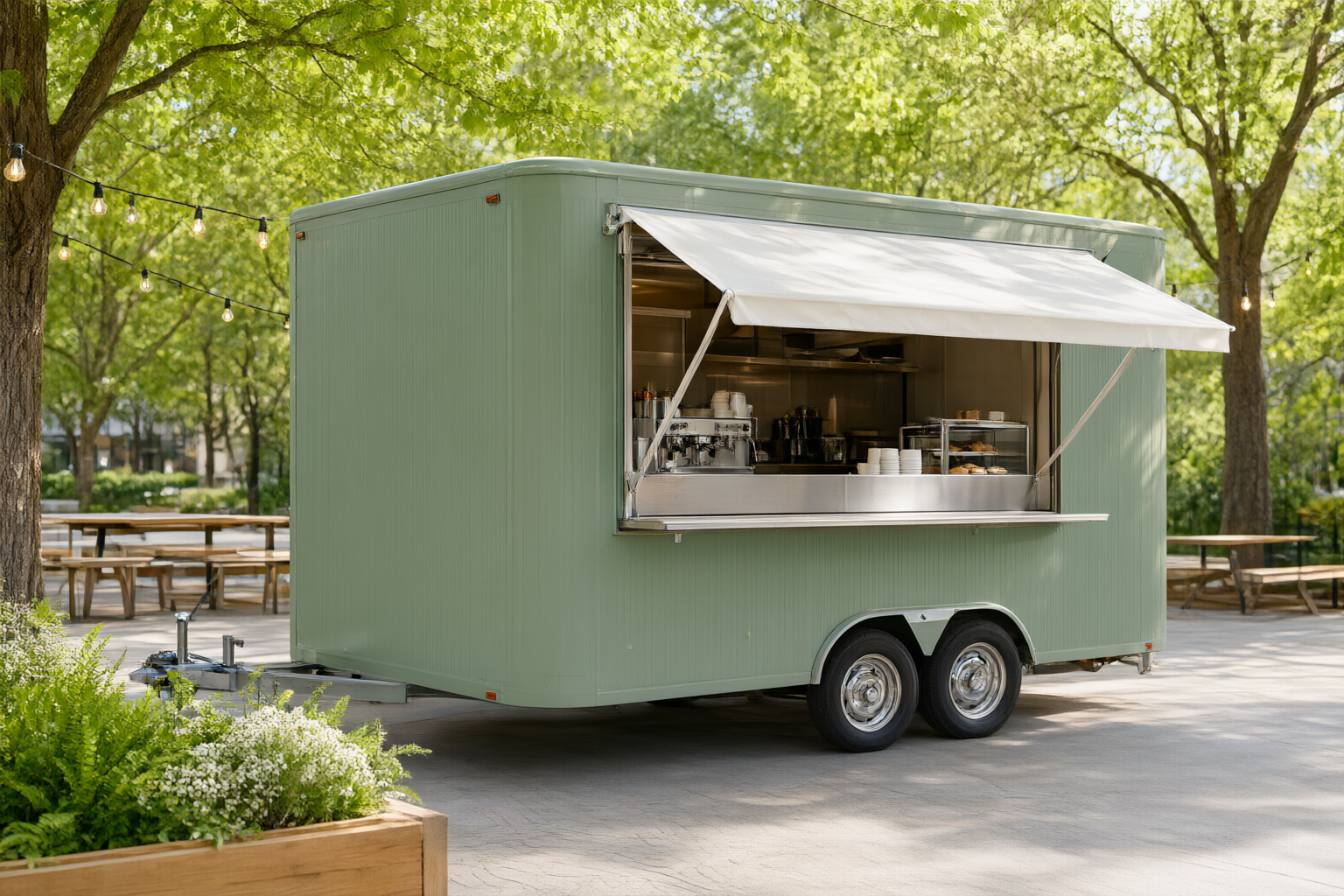
If you’re considering launching a mobile food business in the United States, a food trailer offers flexibility, lower startup costs than a brick-and-mortar restaurant, and strong community visibility—especially at farmers markets, festivals, and high-foot-traffic urban zones. Unlike food trucks, trailers require no dedicated chassis or drivetrain, simplifying maintenance and reducing long-term mechanical risk. But success hinges on navigating local health codes, vehicle compatibility, zoning rules, and smart operational design—not just cooking skill.
Table of Contents
- Why Choose a Food Trailer Over Other Mobile Options
- Legal & Regulatory Basics: Health, Zoning, and Vehicle Compliance
- Towing Requirements: Matching Your Trailer to a Reliable Tow Vehicle
- Trailer Setup Essentials: Layout, Equipment, and Utility Hookups
- Realistic Startup Costs (2024 U.S. Market)
- Choosing Where to Operate: Permits, Pop-Ups, and Long-Term Spots
- Decision Checklist: 7 Questions Before You Buy or Build
- Frequently Asked Questions
Why Choose a Food Trailer Over Other Mobile Options
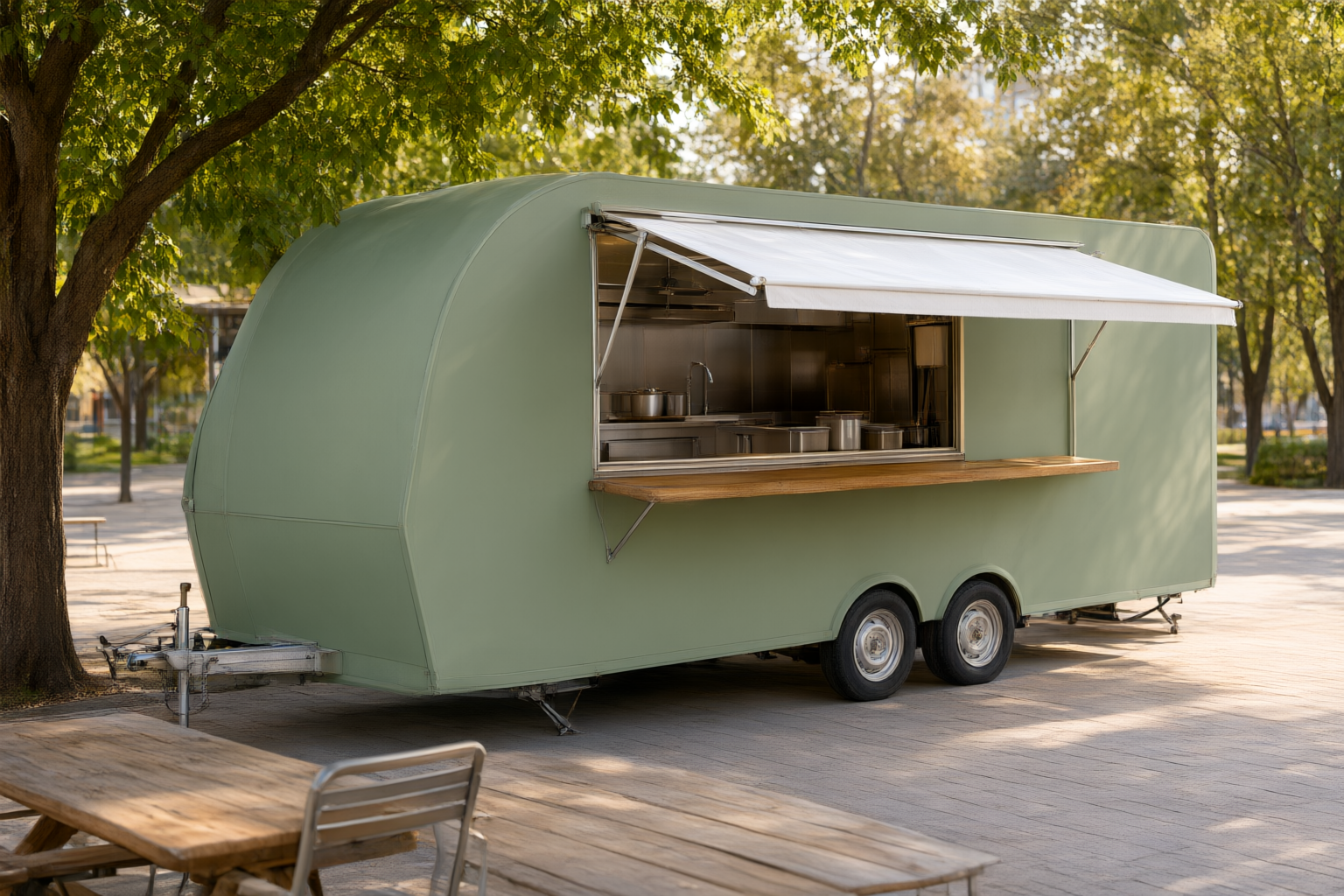
A food trailer is a non-motorized, towable unit designed specifically for food preparation and service. It differs from food trucks (motorized vehicles with engines) and pushcarts (non-towable, human-powered units). In practice, this distinction matters for three key reasons:
- Mechanical simplicity: No engine, transmission, or emissions system means fewer breakdowns, lower insurance premiums, and no state-mandated vehicle inspections beyond standard trailer safety checks.
- Lower initial investment: New custom-built food trailers typically start around $45,000–$85,000, compared to $95,000–$180,000+ for comparable food trucks.
- Regulatory separation: In most states—including California, Texas, Florida, and Ohio—food trailers fall under the same health department licensing as food trucks but are exempt from DMV commercial vehicle registration (though they still require proper trailer plates and lighting).
That said, trailers demand reliable towing capability—and can’t reposition themselves mid-shift. Operators who prioritize stationary, repeat-location service (e.g., weekday lunch at an office park or weekend service at a fixed farmers market) often find trailers more practical than trucks. As seen in verified field use, smash burger trailers operate efficiently in compact, high-turnover settings like U.S. farmers markets—where quick setup, consistent power access, and compact footprint matter more than mobility between stops.
Legal & Regulatory Basics: Health, Zoning, and Vehicle Compliance
There is no federal food trailer license. Regulation occurs at three levels—state, county, and municipal—and enforcement varies widely. Here’s how to verify requirements without guesswork:
Health Department Licensing
All food trailers must obtain a Mobile Food Facility (MFF) permit—or equivalent—from the local health authority. This requires:
- A plan review of your trailer’s layout, including hand-washing station placement, refrigeration specs, grease trap capacity, and ventilation design;
- An on-site inspection before first operation (often scheduled within 5–10 business days of submission);
- Proof of food handler certification for all staff (required in 46 states, including mandatory ServSafe or ANSI-accredited training);
- Documentation of water source (potable, tested), wastewater disposal method (graywater tank or approved drain), and fire suppression system (if using open-flame cooking).
Tip: Some counties (e.g., Maricopa County, AZ; Travis County, TX) offer pre-approved trailer models. If you buy from a vendor whose design is already vetted, your plan review time may shrink by 30–50%.
Zoning & Parking Permissions
Your trailer may be health-permitted but still illegal to park somewhere. Municipal zoning ordinances control where you can operate—especially on public property or private land used commercially. Key distinctions:
- Public right-of-way (sidewalks, streets): Requires separate street use or vending permit—often issued by city transportation or economic development departments. Fees range from $25 to $500/year, depending on city size and duration.
- Private property (e.g., shopping center lots, brewery patios): Requires written permission from the property owner—and sometimes proof that the site has passed a joint health and fire inspection.
- Farmers markets and festivals: Most require application through the event organizer, not the city. Expect insurance minimums ($1M general liability), health permit copies, and sometimes menu pre-approval.
Vehicle & Trailer Compliance
Your trailer must meet federal FMVSS 121 braking standards if over 3,000 lbs GVWR—and all trailers require working lights, reflectors, safety chains, and a properly rated coupler. Most new food trailers sold in the U.S. are built to 7,000–10,000 lb GVWR and include electric brakes, LED lighting, and DOT-compliant axles. Verify compliance by checking for a permanent VIN plate and manufacturer’s certification label—never rely solely on verbal assurances.
Towing Requirements: Matching Your Trailer to a Reliable Tow Vehicle
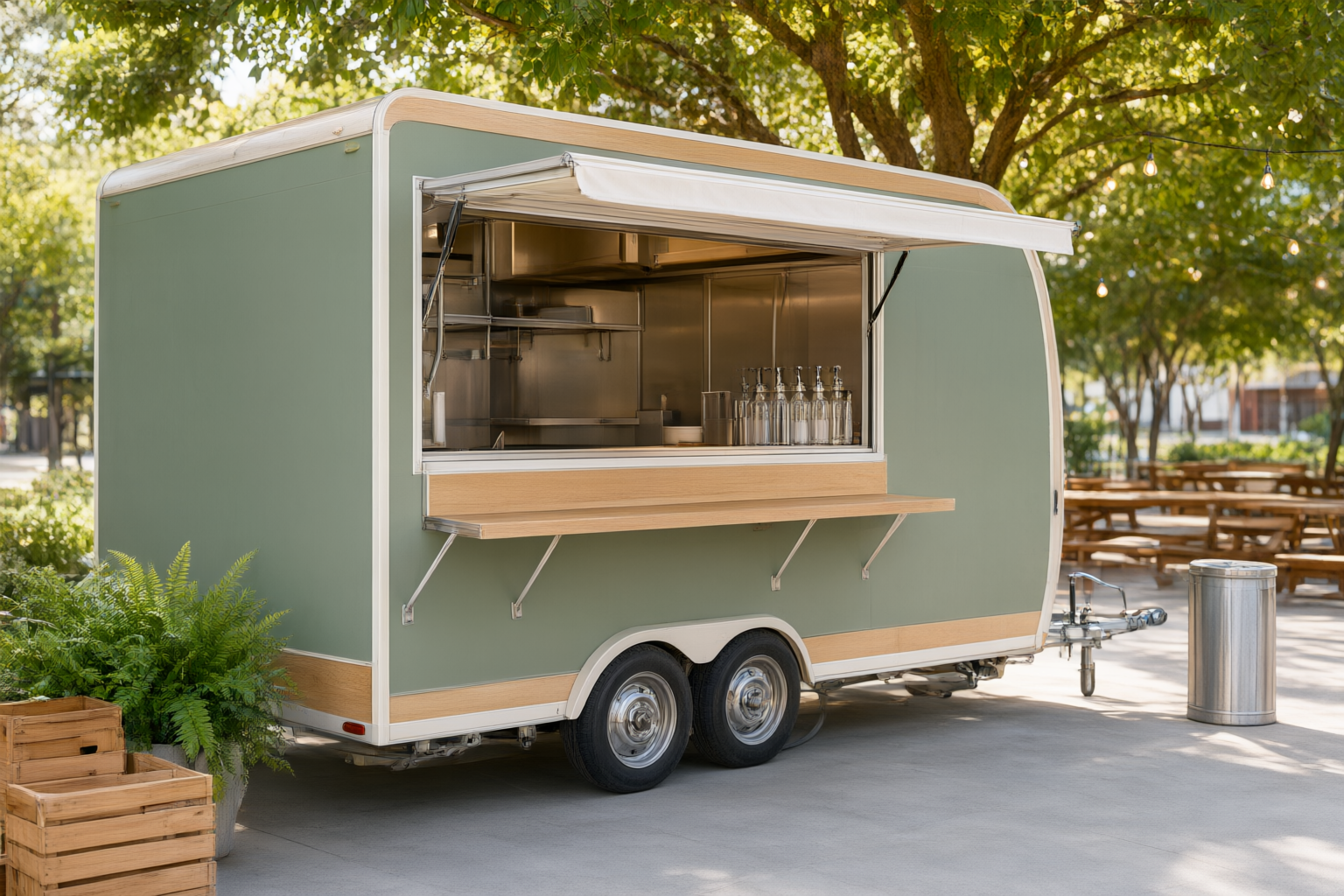
A food trailer’s weight directly determines what you can safely tow. Underestimating this is the leading cause of roadside incidents among new operators. Use these verified thresholds:
- Under 3,500 lbs GVWR: Can be towed by many midsize SUVs (e.g., Toyota Highlander, Honda Pilot) and half-ton pickups with factory tow packages.
- 3,500–7,000 lbs GVWR: Requires a half-ton pickup (e.g., Ford F-150, Ram 1500) with max tow package, 3.55+ axle ratio, and integrated trailer brake controller.
- 7,000–10,000 lbs GVWR: Needs a three-quarter-ton truck (e.g., Ford F-250, GMC Sierra 2500HD) with diesel engine option recommended for sustained hill towing and generator load.
Always confirm your vehicle’s actual towing capacity—not just brochure claims. Check your door jamb sticker for GCWR (Gross Combined Weight Rating) and subtract your vehicle’s curb weight + passengers + cargo. That remainder is your true trailer weight ceiling. For example: A fully loaded 2023 Ford F-150 Lariat with 3.5L EcoBoost and Max Trailer Tow Package has a GCWR of 13,200 lbs. At 5,200 lbs curb weight, with two people (350 lbs) and gear (200 lbs), usable trailer capacity = 7,450 lbs—not the advertised 14,000 lbs.
Also verify hitch class: Class III (up to 6,000 lbs) or Class IV (up to 10,000 lbs) is required for most food trailers. Never use a bumper-pull hitch rated below your trailer’s GVWR.
Trailer Setup Essentials: Layout, Equipment, and Utility Hookups
Efficiency starts with intentional design—not just square footage. Based on field-verified layouts (including smash burger trailers operating at U.S. farmers markets), here’s what delivers real workflow gains:
Core Layout Principles
- Work triangle discipline: Keep grill, prep table, and hand sink within 6 feet of each other—no detours. Avoid “U-shaped” or “island” kitchens unless your trailer is ≥12 ft wide.
- Vertical storage: Wall-mounted shelving and pegboard tool racks free floor space and reduce cross-contamination risk vs. stacked crates.
- Dual-zone refrigeration: Separate units for raw meat (0–3°F) and ready-to-eat items (34–38°F) prevent temperature stacking and pass health inspections consistently.
Power & Utility Planning
Most food trailers run on dual power: shore power (120/240V AC) when docked, and onboard propane for cooking and refrigeration. Critical considerations:
- Generator sizing: A 6,500W dual-fuel (gas/propane) generator supports a flat-top griddle, beverage cooler, POS system, and LED lighting simultaneously. Smaller units (
- Water system: Minimum 30-gallon freshwater tank + 35-gallon graywater tank. Install a pressure regulator (40 PSI max) and backflow preventer—required in 32 states for health code compliance.
- Propane: Two 30-lb ASME-certified tanks (not BBQ-style) with automatic changeover valve and leak detection. Never store propane inside living quarters or near electrical panels.
Realistic Startup Costs (2024 U.S. Market)
Below is a verified cost range based on actual purchase data from U.S.-based manufacturers and operators reporting in Q1 2024. All figures exclude sales tax and delivery fees.
| Item | Low Range | Typical Range | High Range |
|---|---|---|---|
| New custom food trailer (8–12 ft) | $45,000 | $62,000 | $85,000 |
| Used trailer (inspected & permitted) | $22,000 | $34,000 | $49,000 |
| Tow vehicle (used, certified) | $18,000 | $29,000 | $44,000 |
| Health permit & plan review | $350 | $850 | $2,200 |
| Business license & DBA filing | $50 | $180 | $420 |
| Insurance (first year, $1M GL) | $1,200 | $2,400 | $4,100 |
| Initial inventory & supplies | $2,100 | $4,300 | $7,800 |
| Total (low–high) | $86,750 | $133,000 | $194,140 |
Note: Trailers priced below $35,000 often lack NSF-certified surfaces, commercial-grade refrigeration, or structural reinforcement for repeated towing. Always request engineering drawings and third-party weld inspection reports before purchase.
Choosing Where to Operate: Permits, Pop-Ups, and Long-Term Spots
Location strategy drives revenue more than menu alone. Focus on predictability—not just foot traffic.
- Office district lunch programs: Require 6–12 month contracts with property managers. Often include guaranteed spots, shared utilities, and marketing support—but may cap daily sales or mandate menu restrictions.
- Farmers markets: Average booth fee: $25–$125/day. Top-tier markets (e.g., Portland Saturday Market, Ferry Plaza Farmers Market) require waitlists of 6–18 months and proof of $50K+ annual gross sales elsewhere.
- Event partnerships: Breweries, wineries, and music venues increasingly offer turnkey trailer spaces—including parking, power, water, and shared marketing—for 15–25% of gross sales instead of flat fees.
Before committing, test locations with a pop-up permit (offered in 29 states) for up to 14 days per location per year—no full MFF permit needed. This lets you validate demand, observe competitor pricing, and refine service timing without long-term obligation.
Decision Checklist: 7 Questions Before You Buy or Build
Use this objective checklist to avoid costly missteps. If you answer “no” to any item, pause and verify before spending.
- Does the trailer’s GVWR match your tow vehicle’s certified capacity—not just its marketing rating?
- Is the layout reviewed and stamped by a licensed mechanical engineer (required for health plan approval in CA, NY, IL, WA)?
- Are all food-contact surfaces NSF-certified stainless steel (not aluminized or painted steel)?
- Does the trailer include a certified grease interceptor sized for your menu’s projected volume (e.g., 25-gallon minimum for grill-based concepts)?
- Are electrical circuits independently protected (dedicated breakers for fridge, grill, lights) and labeled per NEC Article 555?
- Has the manufacturer provided a written warranty covering structural integrity, axle fatigue, and weld failure for ≥3 years?
- Can you inspect a completed unit—same model, same build specs—operating live at a U.S. farmers market or food hall?
Frequently Asked Questions
Do I need a commercial driver’s license (CDL) to tow a food trailer?
No. A CDL is only required for vehicles or combinations exceeding 26,001 lbs GVWR. Even large food trailers (up to 10,000 lbs) towed by a properly rated pickup do not trigger CDL requirements in any U.S. state.
Can I cook with electricity only—no propane?
Yes, but verify local utility capacity. All-electric trailers require 240V/50A service (like an RV hookup) and high-wattage equipment (e.g., induction griddles drawing 12,000W+). Most farmers markets and parking lots supply only 120V/20A or 30A—insufficient for full electric cooking without load management.
How often does a food trailer need health inspection?
In 41 states, routine inspections occur every 3–6 months. In 9 states (including TN, KS, and SC), annual renewal includes one unannounced inspection. Always keep logs of daily temperature checks, sanitizer concentration tests, and cleaning schedules—they’re requested during every inspection.
Can I finance a food trailer purchase?
Yes. Equipment financing terms (60–84 months, 6.5–11.5% APR) are widely available through USDA-backed SBA 7(a) lenders, credit unions serving small food businesses, and specialty vendors like Balboa Capital. Down payments typically range from 10–20%.
What’s the average timeline from order to first service?
For a new custom trailer: 14–20 weeks (design approval → build → factory testing → health plan submission → inspection → permit issuance). Used trailers with existing permits can begin service in 2–4 weeks—if the health department allows permit transfer (policies vary by county).
Do I need separate insurance for the trailer and tow vehicle?
Yes. Your auto policy covers liability while towing—but excludes damage to the trailer itself and food-related liabilities. You need a commercial inland marine policy for the trailer (covers equipment, contents, transit) plus a separate general liability policy naming your business as insured.
Conclusion
Starting a food trailer business in the United States is achievable—but it rewards preparation, not passion alone. The trailer itself is only one component. Success flows from aligning your equipment to verifiable towing capacity, designing for real-world health inspections—not theoretical efficiency—and selecting locations based on contractual stability, not just crowd size. Operators who treat the trailer as infrastructure—not just a kitchen on wheels—consistently report higher margins, lower downtime, and stronger community relationships. Begin with the decision checklist. Validate every spec against physical evidence. And remember: the goal isn’t to own a trailer. It’s to serve reliably, comply transparently, and grow sustainably—one shift at a time.
